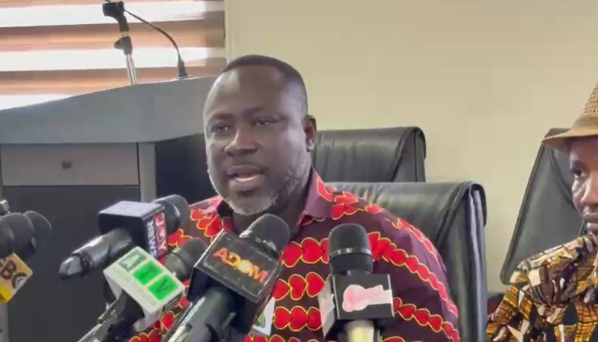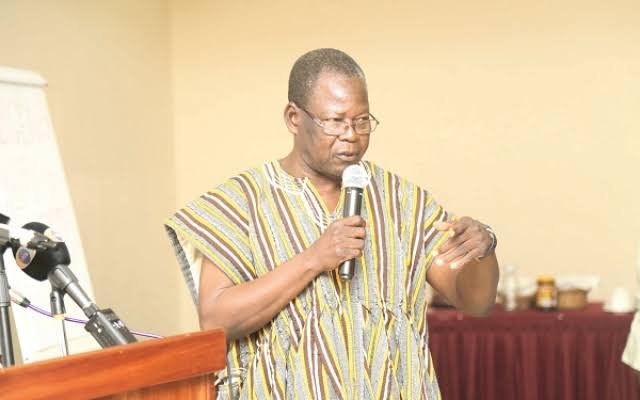
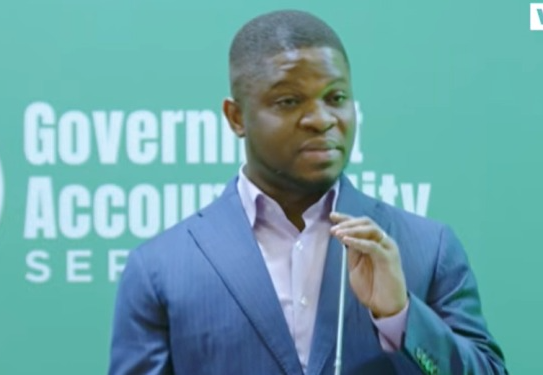
The Chief Executive Officer of the Ghana Gold Board (GoldBod), Sammy Gyamfi, has defended the institution’s role in Ghana’s Domestic Gold Purchase Programme (DGPP), arguing that its responsibilities in 2025 were a continuation of functions previously performed by the defunct Precious Minerals Marketing Company (PMMC).
Speaking at the government’s Accountability Series on Wednesday, August 19, 2026, Mr Gyamfi said GoldBod acted solely as a buying agent for the Bank of Ghana (BoG) under an agreement originally signed between the PMMC and the central bank in September 2023.
He explained that the agreement clearly defined the role of the gold-buying institution as purchasing gold on behalf of the BoG under agreed terms.
“GoldBod’s role under the Domestic Gold Purchase Programme in 2025 was simply a continuation of the inherited role of the defunct PMMC,” he said.
According to Mr Gyamfi, the arrangement was established before he became CEO of GoldBod, noting that he was serving as the National Communications Officer of the opposition National Democratic Congress (NDC) when the agreement was signed.
He said PMMC, which was subsequently transformed into GoldBod, fully accounted for all funds advanced to it to purchase gold on behalf of the central bank.
Mr Gyamfi said the total advances received for the gold purchases amounted to approximately GH¢133 billion, stressing that the funds were specifically provided for GoldBod to carry out its role as a buying agent.
“PMMC, later GoldBod, fulfilled this obligation in strict accordance with its obligations under the 2023 Gold Purchase Agreement and fully accounted for all advances it was given in 2025, a total of about GH¢133 billion,” he stated.
GoldBod had no role in gold sales
Mr Gyamfi further rejected attempts to hold GoldBod responsible for losses arising from the subsequent sale of gold purchased under the programme.
He explained that GoldBod was not involved in selling the gold acquired on behalf of the BoG and was neither a signatory to the offtake agreements nor responsible for determining the selling prices or other terms of the transactions.
“GoldBod had no role in the sale of gold by the Bank of Ghana under the Domestic Gold Purchase Programme,” he said.
He therefore argued that any losses incurred from the sale of the gold should not be attributed to GoldBod simply because the institution had acted as the central bank’s buying agent.
IMF report on 2024 gold losses
The GoldBod CEO also referred to an International Monetary Fund (IMF) report which, he said, indicated that the Bank of Ghana incurred a loss of approximately US$400 million from gold sales under the Domestic Gold Purchase Programme in 2024.
Mr Gyamfi stressed that GoldBod was not in existence at the time, and therefore questioned why the institution should be blamed for losses recorded that year.
He challenged Majority Leader Alexander Afenyo-Markin to identify who should be held responsible for the reported loss.
“There was no GoldBod in 2024. Who then caused that loss? Can Afenyo-Markin answer this simple question?” he asked.