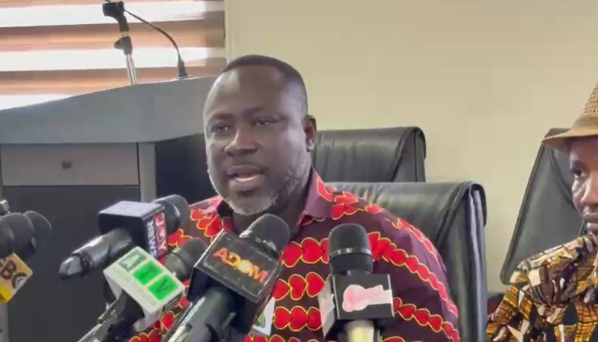

Ghana Gold Board (GoldBod) Chief Executive Officer Sammy Gyamfi has defended his recent remarks directed at Minority Leader Alexander Afenyo-Markin, arguing that his comments were a reaction to what he considers personal attacks against him.
Mr Gyamfi said the dispute was no longer simply about differing views on GoldBod’s financial performance, claiming that the Minority Leader had crossed the line by linking him personally to alleged financial losses and issues surrounding Ghana’s International Monetary Fund (IMF) programme.
Speaking on Newsfile on JoyNews on Saturday, August 22, Mr Gyamfi rejected accusations that he had insulted Mr Afenyo-Markin.
“I never insulted him. And nobody can show me one word that I used that was insulting,” he said.
He likened the exchange to Newton’s Third Law of Motion, arguing that his response was proportional to the comments made against him.
“For every action, there is equal and opposite reaction,” Mr Gyamfi stated.
According to the GoldBod CEO, he has no difficulty with political criticism and is prepared to have his work subjected to public scrutiny. However, he believes Mr Afenyo-Markin’s comments were motivated by malice and went beyond legitimate criticism of government policy.
“When you listen to those criticisms, you see maybe lack of information. But they don’t make it personal. But when you listen to him, you hear malice for Mr Gyamfi,” he said.
Mr Gyamfi particularly took issue with attempts to associate him with financial obligations contained in an IMF report, insisting that the matter did not concern him personally.
“This issue is not about Sammy Gyamfi,” he said, accusing the Minority Leader of attempting to damage his reputation.
Gyamfi turns scrutiny on Afenyo-Markin
In pushing back against the criticism, Mr Gyamfi also subjected Mr Afenyo-Markin’s record in the management of state-owned utility companies to scrutiny.
He claimed that Mr Afenyo-Markin supervised cumulative losses of $3.3 billion at Ghana Water Limited between 2017 and 2024 and later oversaw losses of $8.2 billion at the Electricity Company of Ghana (ECG) in 2024.
Mr Gyamfi stressed that raising those figures was not intended as an insult but rather to demonstrate that public officials, including the Minority Leader, should be open to scrutiny.
“Just like he can criticise me, he’s also not beyond reproach,” he said.
“This is not an insult. I am showing you that this is your record.”
He argued that if Mr Afenyo-Markin was prepared to question his own record at GoldBod, he should equally be willing to have his past record examined.
‘Afenyo-Markin got the response he deserved’
Mr Gyamfi further defended the strong language used during the exchange, questioning why he had been accused of adopting an unusually personal approach.
He said that despite his long involvement in political debates and press conferences, he had not traditionally used terms such as “extortion” against his political opponents.
“Have you ever heard me use the word extortion against any of my critics? Have you ever heard me? Why will I use this word now?” he asked.
The GoldBod CEO suggested that there were additional issues between himself and Mr Afenyo-Markin that had not been made public.
“There are many underlying issues between Afenyo-Markin and I that you don’t know and those watching don’t know,” he said.
Mr Gyamfi maintained that the Minority Leader had not directly challenged the substance of his claims or threatened legal action over his comments.
He therefore stood by his response, stating: “Afenyo-Markin got the response he deserved.”
Despite the ongoing political exchanges, Mr Gyamfi said he remained comfortable with robust political debate and was not intimidated by criticism.
“I’m a consummate democrat. I eat and drink debates because I’m not worried,” he said.
His comments come amid an intensifying political dispute over GoldBod’s financial performance, with both sides continuing to challenge each other’s interpretation of the institution’s accounts and records.