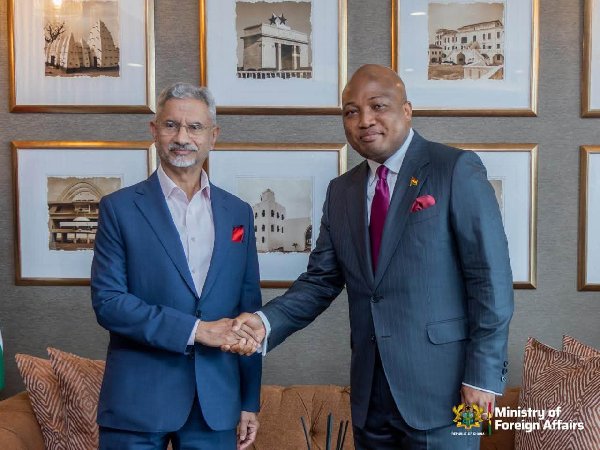
Ghana has decided to formally apply for membership of BRICS, the grouping of major emerging economies, Foreign Affairs Minister Samuel Okudzeto Ablakwa has announced.
According to Mr Ablakwa, the decision forms part of the government’s strategy to diversify Ghana’s international partnerships, create new economic opportunities and deepen cooperation with countries across the Global South.
He made the disclosure during the official visit of India’s External Affairs Minister, Dr Subrahmanyam Jaishankar, to Ghana.
Mr Ablakwa said India’s membership of BRICS made it an important strategic partner in Ghana’s planned application, adding that the government had already approached New Delhi for assistance with the process.
“The major highlight, which I am disclosing to the Ghanaian people for the first time, is that the Cabinet of President John Dramani Mahama has decided that Ghana will be joining BRICS,” he said.
“We believe that joining India in BRICS will give us economic options, will diversify our base and our partnerships, and will also allow us to have more cooperation within the Global South framework, as far as South-South engagements are concerned.”
He said Ghana’s proposed membership would open up additional avenues for economic and diplomatic cooperation while strengthening the country’s relations with partners in the Global South.
Ghana, India strengthen strategic partnership
The BRICS announcement came as Ghana and India moved to deepen cooperation across several sectors.
Mr Ablakwa said the two countries were exploring greater collaboration in railway development, pharmaceuticals, information and communications technology, defence, agriculture, science and technology.
He also disclosed that Ghana and India had signed two Memoranda of Understanding covering agriculture and science and technology as part of efforts to strengthen their comprehensive partnership.
Dr Jaishankar said India was keen to expand cooperation with Ghana in areas including pharmaceuticals, healthcare, mining, defence, railways and digital technology.
He noted that both countries faced similar development challenges and could benefit from sharing knowledge, expertise and experience.
According to him, Ghana’s Accra Reset, Feed Ghana and One Million Coders initiatives have parallels with programmes being implemented in India.
The two countries have also reached agreements covering agricultural research and training as well as biodiversity.
Dr Jaishankar further welcomed Ghana’s role in the African Union and ECOWAS and called for stronger cooperation between Accra and New Delhi at the United Nations.
He also advocated closer coordination on reforms to the UN Security Council as the two countries work to strengthen their strategic partnership.
Mr Ablakwa said Dr Jaishankar was in Ghana for a two-day official visit at his invitation.
He described Ghana and India as “high-grade strategic partners”, noting that their bilateral relations were elevated to a Comprehensive Partnership last year during the state visit of Indian Prime Minister Narendra Modi.
He expressed optimism that the latest engagements would result in further cooperation and concrete agreements between the two countries.