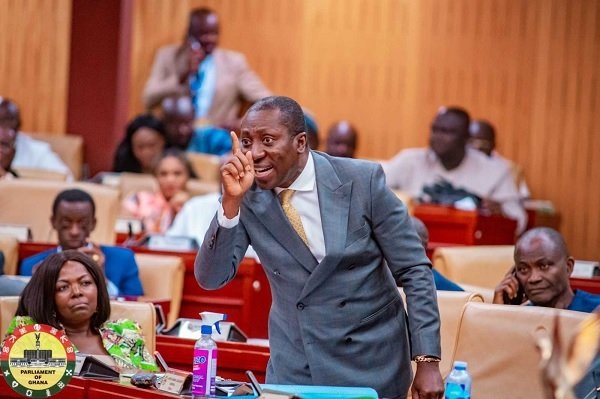
The Minority Caucus in Parliament has accused the government of using state institutions to intimidate political opponents, claiming that members of the opposition are increasingly becoming targets of investigations and prosecutions because of their political views.
The caucus warned that such actions could undermine Ghana’s democratic principles and erode public confidence in the country’s governance system.
Delivering his closing remarks at the end of the Second Meeting of the Second Session of the Ninth Parliament on Friday, July 31, Minority Leader Alexander Afenyo-Markin called on the government to end what he described as the harassment of members of the New Patriotic Party (NPP).
“We say to the NDC government: stop the harassment of the opposition,” he declared.
Mr. Afenyo-Markin alleged that several NPP members, including Minority Members of Parliament, have been subjected to investigations and prosecutions solely because they hold views that differ from those of the governing National Democratic Congress (NDC).
He argued that using investigative and prosecutorial powers against political opponents threatens democratic accountability and weakens trust in public institutions.
“Members of the New Patriotic Party, including Minority MPs, have been maliciously targeted and harassed simply for holding different views through the use of the investigative and prosecutorial powers of the state,” he claimed.
The Minority Leader further stated that any government that seeks to suppress criticism rather than tolerate differing opinions risks weakening the country’s democratic foundations.
“We say, without apology, that this is both dangerous and wrong. A government that fears its critics has already told us something horrifying about itself,” he said.
He also expressed concern that the alleged actions were creating an atmosphere of fear that could discourage citizens and opposition politicians from freely expressing their opinions.
In addition, Mr. Afenyo-Markin questioned several recent court decisions, suggesting they reflected unequal treatment before the law.
“We also place on record a shocking string of doubtful judicial decisions that have emerged in recent times. Taken together, they appear to suggest that there is one set of justice for the friends and cronies of this government and another, altogether harsher, set for its opponents,” he alleged.
He concluded by stressing that a vibrant democracy depends on the ability of the opposition to speak freely and hold the government accountable without intimidation.
“Ghana is bigger than any one party, and our democracy only works if the opposition can speak,” he stated.