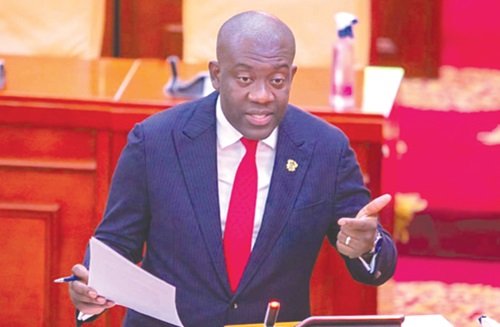
The Supreme Court has dismissed a review application filed by Ofoase Ayirebi MP, Kojo Oppong Nkrumah, challenging an earlier decision that refused his request for an injunction over warrants authorising High Court judges to hear selected criminal cases during the legal vacation.
A three-member panel, presided over by Justice Emmanuel Yonny Kulendi, unanimously dismissed the application on Wednesday, September 2, 2026, ruling that the legislator had failed to meet the strict threshold required for the Court to exercise its limited review jurisdiction.
The Court held that Oppong Nkrumah had not demonstrated the exceptional circumstances necessary to justify a review of the decision by Justice Gabriel Scott Pwamang, who had earlier dismissed his application for an interlocutory injunction.
Delivering the decision, Justice Kulendi said the panel had carefully examined the processes before the Court, including the affidavits, legal arguments and oral submissions made by counsel for both parties.
“Our unanimous decision is that the application failed at the threshold on all grounds and as such ought to be dismissed as unmeritorious,” the Court held.
The full reasons for the decision are expected to be available at the Court’s Registry on September 7, 2026.
What triggered the case
Oppong Nkrumah’s application stems from a substantive constitutional suit challenging the legality and constitutionality of warrants issued to High Court judges to enable them to sit during the legal vacation and hear certain criminal matters.
The warrants concern criminal proceedings involving former National Signals Bureau boss Kwabena Adu Boahen and former National Food Buffer Stock Company CEO Abdul Hanan Wahab.
The MP had asked the Supreme Court to restrain the implementation of the warrants pending the final determination of his substantive constitutional challenge.
However, Justice Pwamang, sitting as a single Justice of the Supreme Court, dismissed the injunction application.
Oppong Nkrumah subsequently invoked the Court’s review jurisdiction, arguing that the ruling contained errors apparent on the face of the record.
Oppong Nkrumah’s arguments
Represented by lawyer Frank Davies, the MP argued that the single Justice had made errors that warranted intervention by the full panel.
A key issue raised by the applicant was the distinction between civil and criminal proceedings during the legal vacation.
Counsel argued that if criminal trials could be conducted during the vacation without the need for a warrant, there would be no basis for issuing the disputed warrants.
He maintained that the single Justice’s position on the issue amounted to an error apparent on the face of the ruling.
The applicant also argued that the single Justice had gone beyond the proper scope of an interlocutory application by making findings that touched on the merits of the substantive constitutional case.
Counsel further challenged the approach adopted in determining the application for an injunction, particularly in relation to the public-interest element.
He argued that the relevant test was whether there was a serious question of law to be tried, rather than whether the applicant had demonstrated a high likelihood of succeeding in the substantive case.
Attorney-General rejects review grounds
The Deputy Attorney-General, Dr Justice Srem-Sai, opposed the application and urged the Supreme Court to dismiss it.
He argued that Oppong Nkrumah had failed to establish any special or exceptional circumstance that would justify the exercise of the Court’s review jurisdiction.
According to him, the review process could not be used to re-argue issues already considered by the single Justice or serve as an appeal against the earlier ruling.
He maintained that none of the eight grounds raised by the applicant met the threshold required for a review.
After considering the arguments from both sides, the three-member panel unanimously dismissed Oppong Nkrumah’s application.